
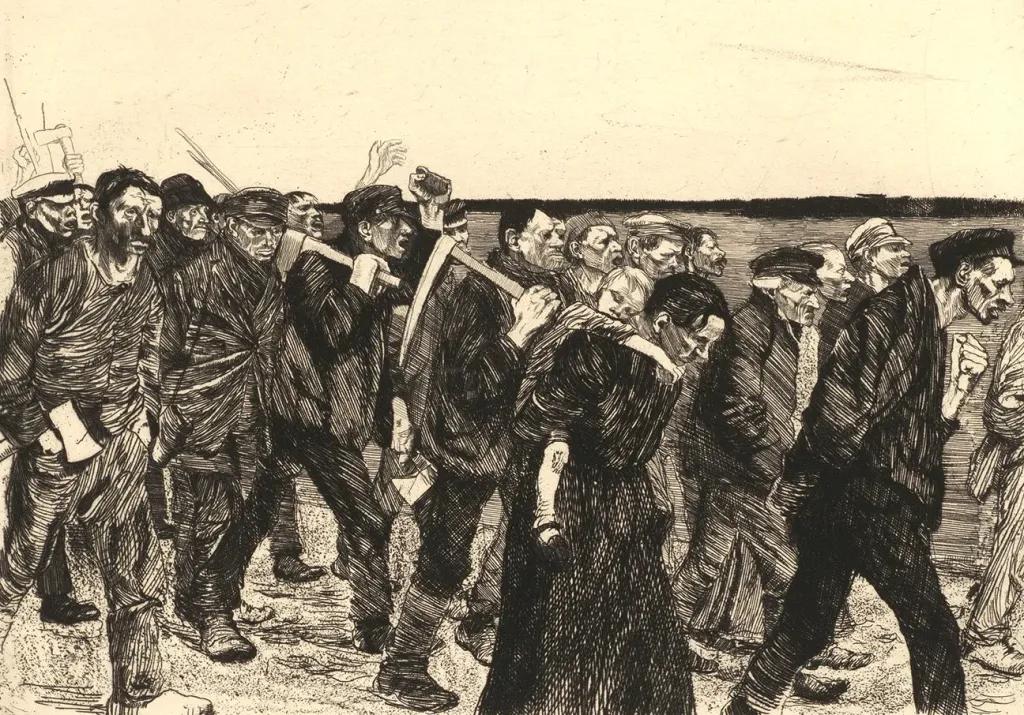
We are republishing Nazariya Magazine‘s May Day statement here, in both PDF and web formats, so that it can be shared and studied in the US revolutionary movement. We find this statement to be a clear demonstration of the necessity to combat opportunism, liquidationism, and revisionism. The comrades affirm the necessity to uphold Marxism through practice in the class struggle, and to overcome the setbacks in the International Communist Movement. We encourage activists in the US to study this document to better understand the situation facing comrades in India, and to better our own work in struggle from within the belly of the beast.
May Day and the Struggle on the Ideological Field
by Kiran, Editorial Board Member of Nazariya Magazine
Whoever has been beaten down must rise to his feet!
Whoever is lost must fight back!
Whoever has recognized his condition – how can anyone stop him?
Because the vanquished of today will be tomorrow’s victors
And never will become: already today!
–Bertolt Brecht, In Praise of Dialectics.
This year’s May Day follows the Indian state’s deadline to eliminate Maoism “of the pen and the gun.” And it succeeded in neither; Marxism-Leninism-Maoism survives in India, both of the pen and the gun. Like a rabid dog of Imperialism without a leash, the Indian state has lashed out against all revolutionary masses and communist forces that refuse to cower, even at the cost of their lives. Trapped as it is, in its role as a subordinate comprador intermediary of imperialism, its standing rising and falling against competing South Asian states vying for the same favours, the state moves to clear all resistance, armed or unarmed, that might push it further into the mounting external and internal economic strain it already faces.
The internal aspect of this life and death class struggle of the proletariat and the bourgeoisie, one that confronts the revolutionary movement not from without but from within it, is the line of Opportunism-Liquidationism-Revisionism (OLR). It is the domain of those who, driven by despair, cannot grasp the causes of setbacks, who bluster where they cannot think, find no way out but to raise a hue and cry about “changing times”, as if it could justify abandoning the most basic precepts of Marxism. On the contrary, for the left-line, the fundamental lessons of Marxism are only affirmed in times of setbacks. Rather than proving the precepts of Marxism wrong, the changing times and setbacks prove them right, and the task at hand is precisely to elevate them to the present situation. Treachery, betrayal, and deception of the International Proletariat, such has been the path of those who tread the path of surrender and liquidating the CPI(Maoist). Our magazine has, in the past, repeatedly helped expose to our readers the treachery of such elements, and clarified with regard to the Maoist position, constructed in continuity with the best lessons of the revolutionary history of communism, the sheer inanity of these trends.
But we must go further and expose the common refuge of those who, having soiled themselves at the tasks confronting the International Proletariat, have fled its ranks. What do these traitors seek? Having abandoned Marxism, they now stand with an insidious smile, shoulder to shoulder with the very butchers who have bled the working masses dry, raising high the document that “does not even have the value of a toilet paper for the vast majority of the Indian people.”1 Constitutionalism, Legalism and Pragmatism, often represented by the parliamentary pigsty, is where our Liquidationists have landed.

And here they are not alone! They stand in good company of the same old labour wing of the bourgeoisie, alongside the various identitarian, pragmatist camps within the Indian ruling class. These forces, at best can only prove to be an impotent challenge to the Indian state’s immediate interests which presently necessitate its turn to Brahminical Hindutva Fascism. But they are crucial for its continued legitimacy among the masses in the long term, and the fascist apparatus too won’t do away with them at one stroke, not as long as they remain the order-bound opposition which still enables the state to make use of the hollow democratic farce. They vie to become the co-managers of the Indian state, including the reproduction of bourgeois and feudal social relations. In a word, they function as the transmission belts of the state between itself and the masses, an inversion of the logic of the communist party’s organs which operate as transmission belts between the party and the masses. Where the latter organise the masses into struggle in the ranks of the conscious proletariat, these forces aim to translate the misery of exploitation back into the logic of the state and its methods of mediating crisis. Though this is not the liquidationists’ only trajectory, as there are also those who stripped of all political direction, persist as fragmented and disorganised elements, pacified into inert complacency and deprived of any sustained will to struggle. But it is not this inert condition that concerns us here; what we aim to challenge is this specific kind of revisionism, which, precisely because it remains active and organised, has demonstrated its capacity to misdirect the masses back into the logic and pacifying mechanisms of the Indian state itself.
‘Damn the words of traitors’; everything was won through revolutionary violence.
We refuse to confine May Day, the product of the struggle of the Proletariat, won through blood, to a mere occasion of revolutionary posturing and chest-beating, the outdated farce of the numerous trends claiming to uphold the ultimate revolutionary brand of Marxism. It is an arena of two-line struggle, for it is only through struggle with revisionism and rightism that Marxism could develop — and develop it must. Far from the idolatrous outlook that treats Marxism as a finished and inviolable doctrine, we, as dialecticians, understand that the proletariat, in the course of its struggle against capital, is continually confronted with new contradictions that demand the revolutionising of its own theory.2 The fight against revisionism, therefore, cannot mean a simple return to orthodoxy. It demands, instead, the conscious and continuous revolutionising of Marxism itself.
What confronts Marxism-Leninism-Maoism in the ideological realm today is the rightism represented by the OLR line that claims the revolutionary doctrine of the proletariat can be reconciled with the constitutional path, that the vanguard party of the proletariat can be constructed legally. When the rightists called for surrender, they said they were doing it for the people. When the rightists and revisionists outside of the revolutionary movement criticise Maoism for its “childish lack of trust in the people”, they accuse it through the same lens. These claims will be addressed one by one, since too often, revisionism elevates the spontaneous demands of the working class into the defining expression of communist politics. The students of Lenin know well how to guard against these cretins. Let us see how the bourgeois intelligence agencies and bureaucracy intervene on behalf of liquidationism in their own words. This is what Badugula Sumathi, chief of the Telangana police’s Special Intelligence Branch, says on the surrender of Devuji:
They are not abandoning their ideology. That has to be understood clearly. He is not negating Marxism-Leninism-Maoism.
What they have come to realise is that operating from deep forests, with weapons, has made them unable to engage with the communication revolution that is happening all around them. And that very communication revolution is what they would need if they want to propagate their ideology at all – their old methods of secrecy and using the barrel of the gun cannot survive in a democratic country . . .
That, for us, is the biggest win. They now believe it is better to pursue their goals through the Constitution rather than from the barrel of a gun – even if the ideology itself remains intact.3
There are more than a few things we could highlight here. First is the usual insistence of bourgeois thought on the centrality of technology and not class struggle as the axis of class war in pursuit of revolution. This alone seals Devuji’s break from Maoism, but that is not his gravest sin. That is, of course, as is pointed out here and proven by the numerous interviews of both the Sonu and Devuji liquidationist camps — although they try to pose as different from each other, they are in essence one and the same — the idea that the strategic goals of the proletariat can be secured through the organs of the enemy class, that the Constitution which serves only to deceive the people, which lets Brahminical Hindutva Fascism function as smoothly as did the ‘Liberal’ establishments of the past, can be reconciled with the ideology that seeks to abolish the present state of things, that seeks to capture state power and further, transform society in its entirety, abolishing classes altogether.
Advocacy of class collaboration; abandonment of the idea of socialist revolution and revolutionary methods of struggle; adaptation to bourgeois nationalism;… making a fetish of bourgeois legality; renunciation of the class viewpoint and the class struggle, for fear of repelling the “broad masses of the population” (meaning the petty bourgeoisie) — such, doubtlessly, are the ideological foundations of opportunism.
–V. I. Lenin4
That is not to say that the legal avenue is of no use to the communists, indeed, the communists aim to utilise all means of struggle, but that is no justification for losing sight of the basic principles of Marxism, the fundamental antagonistic contradiction through which class struggle develops and the centrality of revolutionary violence within it. As Lenin has clarified over and over:
We must not depict socialism as if socialists will bring it to us on a plate all nicely dressed. That will never happen. Not a single problem of the class struggle has ever been solved in history except by violence. When violence is exercised by the working people, by the mass of exploited against the exploiters—then we are for it! And we are not in the least disturbed by the howls of those people who consciously or unconsciously side with the bourgeoisie, or who are so frightened by them, so oppressed by their rule, that they have been flung into consternation at the sight of this unprecedentedly acute class struggle, have burst into tears, forgotten all their premises and demand that we perform the impossible, that we socialists achieve complete victory without fighting against the exploiters and without suppressing their resistance.
–V. I. Lenin5
It is further interesting to note that in the same interview, the SIB chief elaborates on how it actually breaks the ideological foundations of communists, which requires in her opinion, firstly a deep understanding of Maoist ideology, secondly an understanding of the movement and its philosophy, and thirdly, the personal aspects of the leadership and its history, the way it arose from the rank and file. All of this shows the sophisticated and calculated approach the bourgeoisie takes in its goal to dismantle communism. Although it is limited to grasping only certain particularities of Marxism with consistency given its bourgeois world-outlook, instead of understanding it as a universal system that grants the conscious proletariat the role of the universal revolutionary subject that liberates not just itself but all of humanity, it is still quite capable of manipulating the doctrine in a way that helps arm our traitors with their justifications.
But the crux of the matter is that the study of Marxism-Leninism-Maoism, and foremost within it, its military doctrine and analysis, is undertaken quite seriously by the bourgeois intelligentsia and their think tanks. The enemy class, engaged as it is in a life-and-death struggle against the conscious proletariat, demonstrates an immense capacity to grasp the development and science of revolution. It is for this reason that the revolutionary subject must understand that, just as knowledge remains an immutable aspect of the bourgeois class rule, it is equally non-negotiable for a class that aims not to reproduce the conditions of its own exploitation, but to abolish those relations altogether. In an age where the accumulated knowledge of humankind is available at one’s fingertips, a mass whose only strength is its numbers alone is doomed from the start.
But it would mean falling into a grave error for you to try to draw the conclusion that one can become a Communist without assimilating the wealth of knowledge amassed by mankind. It would be mistaken to think it sufficient to learn communist slogans and the conclusions of communist science, without acquiring that sum of knowledge of which communism itself is a result. Marxism is an example which shows how communism arose out of the sum of human knowledge.
–V. I. Lenin6
However, this obfuscation of Marxism is not just limited to a Sonu or a Devuji, but is the basic trend across revisionism in general, even of its most rhetorically “red” wing, one that claims to be the torchbearer of proletarian militancy. An example that underscores this point, can be found in the recent statement of Mazdoor Bigul. Why do we point to the opportunism of this, relatively obscure legalist organisation, after a discussion on the greatest betrayal in history of the communist movement in India? De te fabula narratur — It is of you that the story is told. The confidence they repose, and the theoretical foundations they build around sanctifying the constitutional means of struggle, engaging in the same rotten tradition of “accumulation of forces” through legal means — in the era of imperialism, when the working class movement itself has split into two wings7 — is the concrete expression of the new revisionism of the liquidationists, which leads them to serve immediately and directly the propping up of the mechanisms of the state and the reproduction of the existing relations of production. This is best shown in their recently released statement appealing that the workers on strike in Noida maintain complete observance of legality, decrying any deviation from the Indian state’s imposed “peace” as an Anarchist, Naxalite deviation. It is absolutely treacherous; let us look at their statements’ line in detail.
Noida Labour Strikes and the Limits of Bigul’s Militancy
We cannot rival Mazdoor Bigul and their ideological ilk in the art of slander, which is anyway less creative than it is simply coarse and incessant. It is, we believe, more dizzying for the usual reader than for us, whom they aim it at. We have no desire to descend into that rhetorical theatre with our limited resources and numbers; we aim for clarification over abuse and believe ourselves to still be capable of exposing before our readers the limits of their line.
Since the middle of April this year, industrial and domestic workers across Noida and Greater Noida have been rising up spontaneously, numbering in tens of thousands, for the demands: the minimum wages be raised to ₹20,000 at the very least and be paid on time, an 8 hour work-day with weekends off, double the hourly wage for overtime, and the basic facilities of safety, job security and enforcement of labour laws. Over a thousand workers were detained by the state police for striking; hundreds have been arrested with FIRs against them. The new Labour Codes, brought into force on April 1, have only deepened the precariousness of the working class before capital, most of whom work in Noida on a contractual basis.8 It lets the factory owners lay them off them at will, and has criminalised protests unless pre-cleared by a long notice period to those they protest against; this, coupled with LPG prices soaring to ₹350-500 per kilogramme or more, and the decision of the Haryana government to raise the minimum wage by 35% following worker’s strikes in that state, became the triggering point of these widespread strikes. Protesting activists of various Trade Unions and organisations, including Mazdoor Bigul have also been arrested in these strikes.9 We hereby demand the swift release of all workers and activists that have been detained or arrested in these strikes; if the Indian state calls itself a democracy, not just for the ruling classes — as if standing above class society — but of all people, it must be asked to act like one.
As the strikes reached their peak around 13 April, hundreds of workers forced their way into factories, and in the Motherson plant in Noida, held senior factory staff inside while raising slogans demanding the fulfilment of their demands. Across multiple sites, vehicles belonging to factory owners and management were set ablaze, car windows smashed, and sections of factory property damaged or burned; at a Vipul Motors service centre, windows and frame of 20–25 vehicles were smashed. Roads were blocked, bringing all traffic to a halt, and clashes with the police followed. The state responded with deploying eight companies of PAC and RAF, with Quick Response Teams (QRTs) being stationed at Motherson. Police carried out lathi-charges against the striking workers, including women, fired tear gas into the crowds, and used barricades to disperse them and clear the roads.10 BJP-RSS fascists as well as their lapdog media started weaving nonsensical conspiracies about how these strikes were orchestrated from Pakistan, while the arch-reactionary Uttar Pradesh CM Yogi Adityanath claimed it was an attempt at ‘reviving Naxalism’11 — to which we ask: how can what is not dead be ‘revived’?
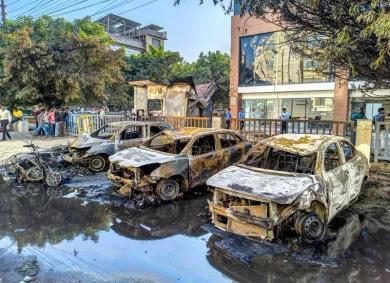
It was amidst this whole episode that the Mazdoor Bigul released a statement titled “Unite peacefully to make the strike movement successful, do not let . . . Yogi government to falsely accuse the workers’ movement and and its activists of “naxalism” and “terrorism”!”12 What this statement shows from the outset, is the wide social abyss separating the ‘labour activist’ (aspiring trade union bureaucrat) intent on keeping the strikes peaceful, legal, and at any cost confined to the economistic dimensions they arise in — from the vengeful labouring mass, the exploited and humiliated proletariat. No longer able to bear the situation which has pressed them beyond the limits of survival itself, the proletarian attacks at the first instance on the centres of power closest to them: factories are seized, here machines are set alight, there cars are smashed, and of course, never does the police avoid the consequences of being the police. Far better initiative and clarity belongs to those unorganised workers whose first instinct — birthed from the daily weight of class society — is not to wait for permission of either the factory owner or the state to choose the hour to strike, than the Bigulites for whom legality is already the horizon of struggle, who believe economic interruption of the state alone to be sufficient for the worker’s movement, and who, with a peculiar earnestness censure the state for acting like the state. Their statement goes as follows:
We have to run our movement in a disciplined and organised manner. The thing that actually bothers the owners and the management is – strike. Because strike means – the work stops and their wheel of exploitation churns to a halt. Beyond this, nothing else matters to them. For our strike to continue successfully, it is essential that we conduct our protests and demonstrations in a completely peaceful manner, avoiding any provocation, and avoiding any law and order situation.13 [bold in the original]
Their statement concedes two things: that the present movement is truly unorganised, that is spontaneous, and that the government is keen on repressing it. Further, it believes that the state has to wait until the strikes escalate into “anarchy” before it begins the repression. Bigul opines that this pre-condition itself is inviolable to make this a countrywide worker’s protest. This comes from the same old rotten trade-unionist logic of the Bernstenian kind which opines “social democracy would flourish far better by lawful than by unlawful means and by violent revolution.”, “that the next task of the party should be “to work for an uninterrupted increase of its votes” or to carry on a slow propaganda of parliamentary activity.”14 One could easily imagine that if a section of the working class chose to defy this pacifist approach they would simply lable it as external sabotage, done by some agent provocateur rather than something possible within the spontaneous activity of the working class — same line of reasoning as the lapdog news media and fascist politicians.
Further, they assert “peaceful strike” as prescriptive, and not simply a feature of the strike: “This is a matter between the workers and the owners and management. Unless unruly elements, provoked by the police, take some inappropriate action, the police have no role in this labor dispute. And without the police, the owners-management will be ultimately forced to listen to your demands.” We doubt Mazdoor Bigul is naive enough to believe this. It is not, it either believes the masses are not upto the task of understanding the class nature of the Indian state, or it is simply aiming to deceive them to justify its own cowardice. Indian state is treated here as a neutral entity, as if detached from the factory owner ruling class, as if the police is not an institution of this class-rule. This is not a tactical suggestion aimed at avoiding repression or maintaining unity; it is presented as a general principle governing the correct development of the worker’s movement — a strategic prescription. In effect, it establishes a normative boundary around the forms of struggle deemed legitimate mirroring the state’s own logic. Now, the Leninist understanding regarding the forms of struggle of the communists is indeed contingent upon a detailed examination of the concrete situation at the given moment — and they can always try to hide behind that, dress any revision up as “tactics dictated by the moment” — but nowhere does it ascribe such a strategic dimension to legalism and pacifism. They make no mention of the final aim of the proletariat anywhere at all, as Engels has noted of this sort of reasoning, “This forgetting of the great, the principal considerations for the momentary interests of the day, this struggling and striving for the success of the moment regardless of later consequences, this sacrifice of the future of the movement for its present, may be “honestly” meant, but it is and remains opportunism, and “honest” opportunism is perhaps the most dangerous of all!”.15 On the contrary, for the Bolshevik communist, strikes are a school of war, which when consciously guided, expose to the workers en-masse, who the enemy is and what class is responsible for their exploitation:
The worker does not know the laws, he has no contact with government officials, especially with those in the higher posts, and, as a consequence, often believes all this. Then comes a strike. The public prosecutor, the factory inspector, the police, and frequently troops, appear at the factory. The workers learn that they have violated the law: the employers are permitted by law to assemble and openly discuss ways of reducing workers wages, but workers are declared criminals if they come to a joint agreement! . . . The workers begin to understand that laws are made in the interests of the rich alone; that government officials protect those interests; that the working people are gagged and not allowed to make known their needs; that the working class must win for itself the right to strike, the right to publish workers’ newspapers, the right to participate in a national assembly that enacts laws and supervises their fulfilment . . . Every strike strengthens and develops in the workers the understanding that the government is their enemy and that the working class must prepare itself to struggle against the government for the people’s rights.
Strikes, therefore, teach the workers to unite; they show them that they can struggle against the capitalists only when they are united; strikes teach the workers to think of the struggle of the whole working class against the whole class of factory owners and against the arbitrary, police government. This is the reason that socialists call strikes “a school of war,” a school in which the workers learn to make war on their enemies for the liberation of the whole people, of all who labour, from the yoke of government officials and from the yoke of capital.
–V. I. Lenin16
However, even a massive strike that paralyses industry doesn’t automatically translate into political power for the workers, and moreover, strikes in and of themselves are a natural, recurring part of capitalism. The ruling class doesn’t simply rely on the production continuing — it relies on control of the state and its machinery, the army, the police, the banks, and a whole system of transmission belts that bridge the gap between itself and the masses. Strikes are a school of war, not war itself. As long as state power remains absent from worker’s hands, the bourgeoisie is very capable of enduring losses, drawing on the reserve army of labour and shifting production elsewhere, importing goods, or simply waiting the strikes out. More importantly, it does not need any ‘trigger’ from the striker’s end to begin repression either, the state cares much less about its laws and constitution than our Gandhian trade unionists, it can simply lie if it needs any pretext to begin with, and it has done so countless times already. The statement of Mazdoor Bigul is even worse than one which Engels derided Dühring for: “It is only with sighs and groans that he admits the possibility that force will perhaps be necessary for the overthrow of an economic system of exploitation—unfortunately, because all use of force demoralises the person who uses it. And this in spite of the immense moral and spiritual impetus which has been given by every victorious revolution!”17 — Mazdoor Bigul does not even concede that force may somewhere, at some distant time be required, for that is Naxalism.
The Struggle Against Revisionism Is a Struggle Against the Worship of Spontaneity
Among the fundamental tenets of Revisionism, is to consider the legitimate, immediate demands of the proletariat class-in-itself, as the genesis as well as the very raison d’etre of the “revolution”, and that social revolution is a deterministic process toward which we are automatically headed. The students of Lenin, on the other hand, understand that revolutionary consciousness can only come to the working class movement from without, from outside of its immediate conditions. We understand Marxism, the synthesis of accumulated knowledge and the practice of human history in class struggle, which — having become the worldview of the conscious proletariat, granting to this last class of history the role of the universal subject — has become the universal worldview, and therefore compels the working class, to negate itself as merely economic proletarians, and instead to become the tribune of the people. Subordinating this class-for-itself consciousness of the proletariat, to the spontaneous, immediate, everyday demands of the working class, as a mere economic class and the legalist trade union movement that relies on it can only hurt the communists:
Social-Democracy (the term ‘Social Democracy’ until then had not shed its revolutionary character and was synonymous with Communism — Ed.) leads the struggle of the working class, not only for better terms for the sale of labour-power, but for the abolition of the social system that compels the propertyless to sell themselves to the rich. Social-Democracy represents the working class, not in its relation to a given group of employers alone, but in its relation to all classes of modern society and to the state as an organised political force. Hence, it follows that not only must Social-Democrats not confine themselves exclusively to the economic struggle, but that they must not allow the organisation of economic exposures to become the predominant part of their activities.
–V. I. Lenin18
Natural complement to revisionism’s worship of spontaneity and, its manifestation in the realm of struggle as trade unionist economism, is to disregard the ultimate aim of the communist movement, is to justify its conduct on a case-to-case, pragmatist basis sacrificing the primary interests of the proletariat for immediate victories and assumed advantages. In their struggle against the pacifist “Zurich Trio” within the SPD, Marx and Engels vividly pointed out the class-nature of such ideas:
In order to relieve the bourgeoisie of the last trace of anxiety, it is to be shown clearly and convincingly that the red spectre really is just a spectre and doesn’t exist. But what is the secret of the red spectre, if not the bourgeoisie’s fear of the inevitable life-and-death struggle between itself and the proletariat, fear of the unavoidable outcome of the modern class struggle? Just abolish the class struggle, and the bourgeoisie and “all independent persons” will “not hesitate to go hand in hand with the proletarians”! In which case the ones to be hoodwinked would be those self-same proletarians. Let the party, therefore, prove, by its humble and subdued demeanour, that it has renounced once and for all the “improprieties and excesses” which gave rise to the Anti-Socialist Law. If it voluntarily undertakes to remain wholly within the bounds of the Anti-Socialist Law, Bismarck and the bourgeoisie will, no doubt, oblige by rescinding what would then be a redundant law! . . . Then, too, the bourgeois, petty-bourgeois and workers, who “are now scared off … by ambitious demands”, will join us en masse.
–Karl Marx and Friedrich Engels19
When revisionism sacrifices the ‘spectre of communism’ for the goodwill of the bourgeoisie, the bourgeoisie too rewards it with the formal acceptance of the proletariat’s right to class struggle within a legal framework, narrow enough to render it harmless. In the era of Imperialism, in the era of split in the working class movement, the section of the working class represented by the Labour Aristocracy which is already bribed out by the bourgeoisie, and the rearguard of the working class which aspires for a better position within the existing production system rather than breaking free of it, are the quickest to make this transaction. And it is for this reason that, the development of the proletariat as a political class is currently only possible as a revolutionary class, that is, from outside the legal framework and from outside its economic and reformist movements, which are the political reflection of its restricted condition as an economic class. Then, for revolutionaries, treating the spontaneous class struggle, the usual trade unionism as the beginning and central axis of the political development of the working class represents, more than anything, a hidden desire to postpone the proletariat’s confrontation with capital in terms of the revolutionary war — a war which is already underway in India.
To build from the ranks of the proletariat that immense social force capable of leading this revolutionary process while simultaneously transforming the old world in its wake, the communists, having grasped the revolutionary doctrine of Marxism-Leninism-Maoism, will have to combat the decades of rot that have creeped-in in the general understanding of the proletariat’s doctrine, whose new manifestation is the OLR-line. Against the social-traitors, against reformism and opportunism, the proletariat cannot advance but by combating it in all spheres without exception.20 Comrade Mao Zedong has said, “The proletariat seeks to transform the world according to its own world outlook, and so does the bourgeoisie. In this respect, the question of which will win out, socialism or capitalism, is not really settled yet. Marxists remain a minority among the entire population as well as among the intellectuals. Therefore, Marxism must continue to develop through struggle. Marxism can develop only through struggle, and this is not only true of the past and the present, it is necessarily true of the future as well.”21 And so it remains true. The task that therefore remains for us, is to develop our understanding of Marxism, as well as grasp the way in which our doctrine itself must be revolutionised, to defeat the setbacks and the retreat communism is facing — not just of the Indian revolution but in the whole ICM, for the future that must be conquered. We wish to our readers, a studious May Day.
References
1 The full quote reads “Lastly, Herr Verghese fondly hopes: ‘The Maoists will fade away, democratic India and the Constitution will prevail, despite the time it takes and the pain involved.’ If the Maoists fade away by the superiority of your development model, then why are the advocates of your development keen on brutally suppressing the Maoists and the adivasis they are leading? In which part of India is the Constitution prevailing, Mr Verghese? In Dantewada, Bijapur, Kanker, Narayanpur, Rajnandgaon? In Jharkhand, Orissa? In Lalgarh, Jangalmahal? In the Kashmir Valley? Manipur? Where was your Constitution hiding for 25 long years after thousand of Sikhs where massacred? When thousands of Muslims were decimated? When lakhs of peasants are compelled to commit suicides? When thousands of people are murdered by statesponsored Salwa Judum gangs? When adivasi women are gangraped? When people are simply abducted by uniformed goons? Your Constitution is a piece of paper that does not even have the value of a toilet paper for the vast majority of the Indian people.”. Cherukuri Rajkumar (Azad). A last note to a neo-colonialist. Published posthumonsly in Outlook. (2010).
2 “We do not regard Marx’s theory as some thing completed and inviolable; on the contrary, we are convinced that it has only laid the foundation stone of the science which socialists must develop in all directions if they wish to keep pace with life.”. V. I. Lenin. Our programme. Rabochaya Gazeta. (1899).
3 This is an interview of the SIB chief, IPS officer B. Sumathi where she explains how her intelligence agency secured the surrender of Devji. Prasanna D. Zore. The lady who got a dreaded maoist to surrender. Rediff.
4 V. I. Lenin. The position and tasks of the socialist international. (1914).
5 V. I. Lenin. Third all-russia congress of soviets of workers’, soldiers’ and peasants’ deputies. (1918).
6 V. I. Lenin. The tasks of the youth leagues. (1920).
7 V. I. Lenin. Imperialism and the split in socialism. (1916).
8 T. K. Rajalakshmi. What noida’s worker strikes tell us about the labour codes’ broken promise. Frontline.
9 Noida workers’ protest: Lawyers, activists allege ’witchhunt’ by UP police, illegal detentions, false narratives. The Wire.
10 Noida protest highlights. India Today.
11 Was noida workers’ protest hijacked? The Times of India.
12 Mazdoor bigul statement dated 13 april.
13 Ibid.
14 Eduard Bernstein. Evolutionary socialism. (1899).
15 Friedrich Engels. Critique of the draft of the Erfurt programme. (1891).
16 V. I. Lenin. On strikes. Rabochaya Gazeta. (1899).
17 Friedrich Engels. Anti-dühring, part II: Political economy, IV. Theory of force. (1877).
18 Also: “The spontaneous development of the working-class movement leads to its subordination to bourgeois ideology.”. V. I. Lenin. Chapter III. Trade-Unionist Politics and Social-Democratic Politics, What Is to Be Done. (1901).
19 Karl Marx Friedrich Engels. Circular letter to august bebel, wilhelm liebknecht, wilhelm bracke and others. (1879).
20 “Fight against the social-traitors, against reformism and opportunism—this political line can and must be followed without exception in all spheres of our struggle. And then we shall win the working masses. And the vanguard of the proletariat, the Marxist centralised political party together with the working masses will take the people along the true road to the triumph of proletarian dictatorship, to proletarian instead of bourgeois democracy, to the Soviet Republic, to the socialist system.”. V. I. Lenin. Greetings to italian, french and german communists. (1919).
21 Mao Zedong. On the correct handling of contradictions among the people. (1957).
 Jal-Jangal-Jameen USA